Vietnamese Diaspora: The Ongoing Journey of Conflict and Reconciliation
Fifty years after the fall of Saigon, the panel “Vietnamese Diaspora: The Ongoing Journey of Conflict and Reconciliation,” highlighted personal and intergenerational experiences of loss, resilience, and renewal, offering insight into how the Vietnam Wars continue to shape Vietnamese communities today.
While the Vietnam Wars are remembered through the lens of conflict and loss, the panel “Vietnamese Diaspora: The Ongoing Journey of Conflict and Reconciliation” invited audiences to look beyond these familiar narratives, highlighting resilience, creativity, and renewal within Vietnamese communities worldwide. The panel set the tone for “Fifty Years On: New Perspectives on the Vietnam Wars,” a two-day conference at Harvard University hosted by the Global Vietnam Wars Studies Initiative (GVWSI). Convened 50 years after the fall of Saigon, the conference aimed to broaden dialogue on the wars’ global and intergenerational impacts, exploring how they continue to shape politics, memory, and reconciliation today.
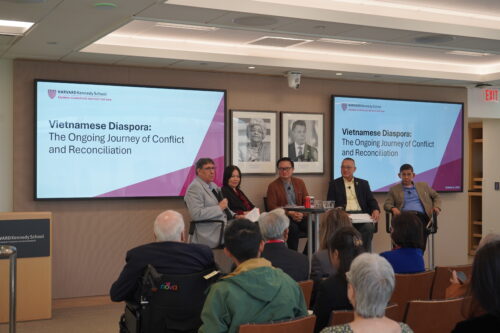
Held on Thursday, October 2, this opening panel brought together four voices from South Vietnam to reflect on the complex legacies of identity, loss, and belonging. Their conversation traced how the Vietnamese diaspora has transformed inherited pain into strength, with Vietnamese communities emerging as a force in culture, technology, and civic life. Together, the panelists explored what their experiences reveal about the ongoing work of healing and what lessons they offer for a world still grappling with the wars.
Anthony Saich, director of the Rajawali Foundation Institute for Asia and Daewoo Professor of International Affairs at the Harvard Kennedy School, moderated the discussion. The panel featured Mai Elliott, Pulitzer Prize nominee and author of The Sacred Willow: Four Generations in the Life of a Vietnamese Family and RAND in Southeast Asia: A History of the Vietnam War; Christopher Nguyen, CEO and cofounder of Aitomatic and former engineering director at Google; Tuan T. Ton, former senior defense official and defense attaché to Vietnam; and Julian Tran, former commander of the U.S. Defense POW/MIA mission in Hanoi and director for Southeast Asia at Sierra Nevada Corporation.
Saich opened by describing the panel as a “curtain raiser” for the broader themes of the conference: memory, reconciliation, and legacy in the 50 years since the fall of Saigon. He noted that the Vietnamese diaspora embodies “an extraordinary story related to struggle, reinvention, and, I think most importantly, resilience,” and expressed hope that the conversation would “move beyond the familiar narrative of survival and loss [to highlight] the extraordinary creativity — the leadership and the contributions — that has made this community one of the most dynamic diasporas in the United States and beyond.”
Each panelist began by sharing how their personal or family histories span the past 50 years and continue to influence their experiences in the United States. First, Elliott recounted her family’s journey from Hanoi in 1954 to their evacuation from Saigon in 1975. Although part of the urban middle class, she said, “they did not escape the anxiety and fear of a lot of Vietnamese.” The war reached them during the Tet Offensive of 1968, marking their first flight from danger. When they evacuated Saigon by American helicopter in 1975, it was the fifth time they had fled, “but this time to a foreign land,” she explained, noting her family’s mixed emotions. “… they thought they were saved from a very perilous future. So, it was both despair and hope at the same time.”
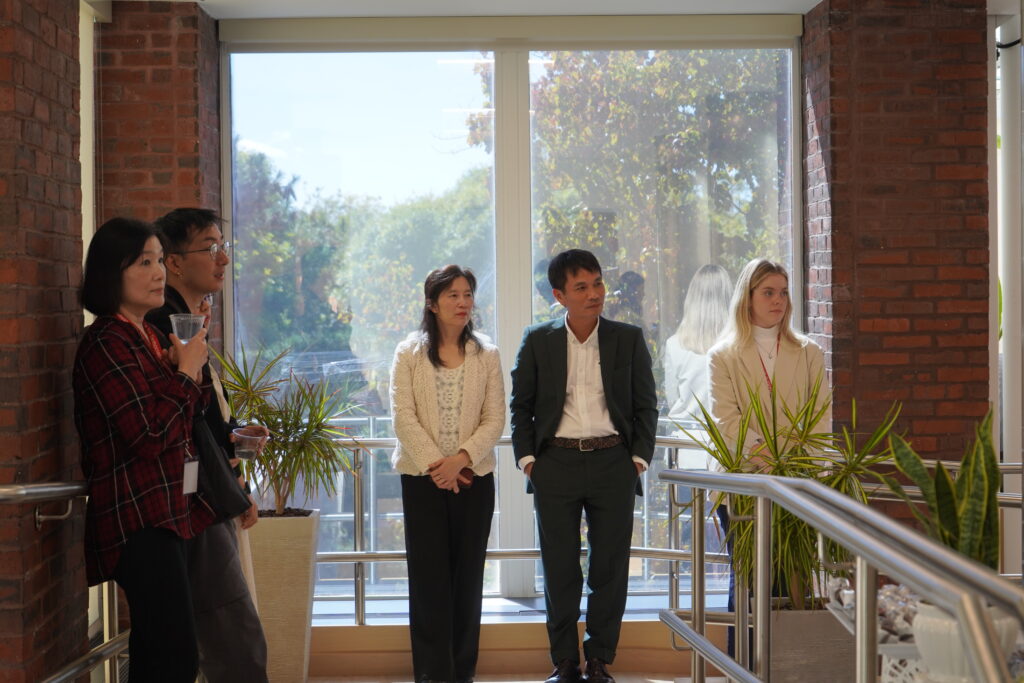
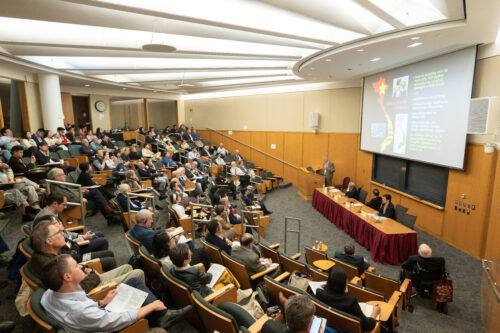
Hai Nguyen (center), Director of the Unseen Legacies of the Vietnam War Project and Global Vietnam Wars Studies Initiative, and Program Assistant Sophie Koritz (far right), listens along with guests.
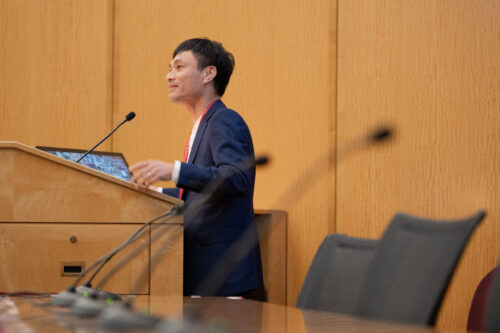
Nguyen was nine when the war ended, and his father, a lieutenant colonel in the Army of the Republic of Vietnam (AVRN), stayed in Saigon after reunification. He recalled his father asking, “How bad could things get?” Things, Nguyen said, “did get very bad.” His father was imprisoned and moved through multiple camps, while the family endured years of hardship before finally escaping. Nguyen ultimately arrived in Silicon Valley at the dawn of the tech revolution and now sees his story as one of transformation rather than victimhood. All Vietnamese, he argued, were “pawns” in a larger conflict, but true reconciliation begins when people claim “a destiny greater than what has been defined by that war … There are many stories we don’t like to tell … but I choose to look at the future, and I actually think of my life as having been very lucky.”
Tuan T. Ton then reflected on returning decades later to Hanoi as the son of an ARVN soldier now representing the American military as a U.S. defense attaché. Asked how his family history shaped his work, he asserted, “There’s no such thing as a Vietnamese American military. It’s only American military.” Ton offered two broader reflections: clarifying identity and building trust. On identity, he urged a more nuanced understanding of the Vietnamese diaspora: “Many of us … no longer see ourselves as in exile. We arrived as refugees, but the journey from refugee to citizen is complete. We are American.” On trust, he noted how the United States and Vietnam have progressed from enemies to strategic partners, “one step at a time,” emphasizing that dialogue and consistent engagement are key to reconciliation.
Finally, Julian Tran reflected on what Saich called “one of the most painful legacies of the war”: accounting for those still missing in action. Sharing his own story of loss, he described losing two brothers and two uncles, while his father, once prosperous, lost everything after 1975. Tran himself fled through Cambodia, where two of his party were killed. “I was a lucky one,” he said. After time in prison and refugee camps, he was resettled in the United States. “America is the only country that gave me the opportunity to be who I am and what I am today,” he reflected. He went on to serve 28 years in the U.S. military and now dedicates his life to locating the 1,566 Americans still missing. “Even if freedom is short-lived… at least we know what freedom means,” he said. “You cannot rebuild the past. You can look forward into the future.”
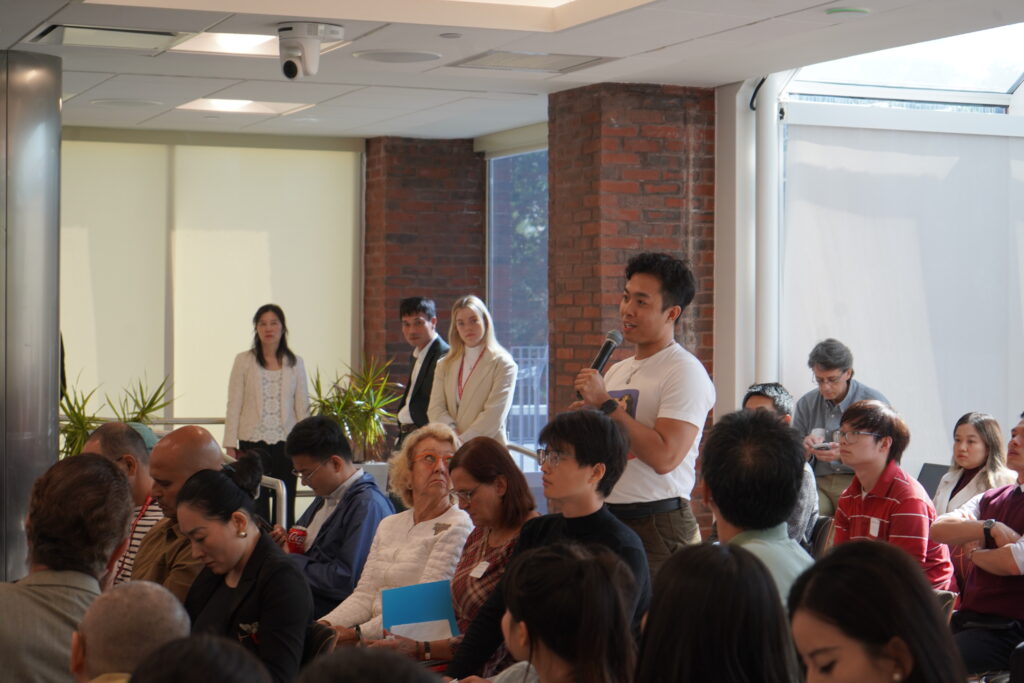
An audience member speaking to the panelists.
As the discussion opened to questions and reflections from the audience, participants discussed their own experiences with the war, its legacies, and what comes next. Đoan Hoang Curtis, producer of Turning Point: The Vietnam War, recalled being airlifted from Saigon as a child, an experience that shaped her storytelling. Second-generation Vietnamese Americans reflected on redefining connections to Vietnam and its history. Elliott noted that many young people in Vietnam “really moved on,” focusing on the future rather than the war’s legacy, while Nguyen emphasized that understanding history matters because “it could happen again,” urging young people to lead with awareness. “The future …is going to be led not by people like us, it’s going to be people like you.”
Fifty Years On: New Perspectives on the Vietnam Wars – Day Two
The second day of Fifty Years On: New Perspectives on the Vietnam Wars continued the conversations from Day One, exploring the wars’ lasting global and human impact. Building on the first day’s scholarship and personal reflections, Day Two featured three panels and a final roundtable. A first article covers Day One.
Fifty Years On: New Perspectives on the Vietnam Wars – Day One
The first day of the Fifty Years On: New Perspectives on the Vietnam Wars conference presented new scholarship and firsthand reflections that expanded how the Vietnam Wars are remembered and studied. Scholars, veterans, and practitioners examined the conflict from multiple perspectives, centering Vietnamese and other international voices often missing from traditional narratives. A second article covers Day Two.
Reflections on the Vietnam Wars and Frank and Catherine Jao’s Role in Advancing Reconciliation
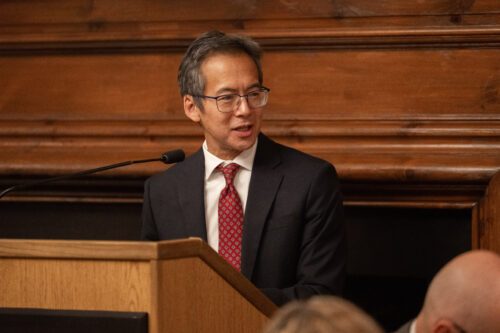
Wars end, but the story of how they are remembered, and how people heal from them, continues. On Friday, October 3, during Fifty Years On: New Perspectives on the Vietnam Wars — a two-day conference hosted by Harvard University’s Global Vietnam Wars Studies Initiative — Archon Fung, Winthrop Laflin McCormack Professor of Citizenship and Self-Government and director of the Ash Center for Democratic Governance and Innovation, shared remarks reflecting on memory, reconciliation, and the enduring lessons of conflict. Convened 50 years after the fall of Saigon, the conference brought together scholars, veterans, and practitioners to explore how the wars in Vietnam, Cambodia, and Laos continue to shape politics, remembrance, and global relationships today.
Fifty Years On: New Perspectives on the Vietnam Wars – Day Two
The second day of Fifty Years On: New Perspectives on the Vietnam Wars continued the conversations from Day One, exploring the wars’ lasting global and human impact. Building on the first day’s scholarship and personal reflections, Day Two featured three panels and a final roundtable. A first article covers Day One.
Fifty Years On: New Perspectives on the Vietnam Wars – Day One
The first day of the Fifty Years On: New Perspectives on the Vietnam Wars conference presented new scholarship and firsthand reflections that expanded how the Vietnam Wars are remembered and studied. Scholars, veterans, and practitioners examined the conflict from multiple perspectives, centering Vietnamese and other international voices often missing from traditional narratives. A second article covers Day Two.
Reflections on the Vietnam Wars and Frank and Catherine Jao’s Role in Advancing Reconciliation
Wars end, but the story of how they are remembered, and how people heal from them, continues. On Friday, October 3, during Fifty Years On: New Perspectives on the Vietnam Wars — a two-day conference hosted by Harvard University’s Global Vietnam Wars Studies Initiative — Archon Fung, Winthrop Laflin McCormack Professor of Citizenship and Self-Government and director of the Ash Center for Democratic Governance and Innovation, shared remarks reflecting on memory, reconciliation, and the enduring lessons of conflict. Convened 50 years after the fall of Saigon, the conference brought together scholars, veterans, and practitioners to explore how the wars in Vietnam, Cambodia, and Laos continue to shape politics, remembrance, and global relationships today.