One Country, Two Systems at a Crossroads: Hong Kong’s Opportunities and Challenges
In-Person Event
Ash Center Room 225, Suite 200 124 Mount Auburn Street
12:00 pm – 1:15 pm EST



Answering the big questions about China’s future and its changing role in the world
Asia Energy and Sustainability Initiative, China and the World, China Philanthropy Project, China Public Policy Program
How do China’s politics and policies continue to evolve in the 21st century? Can the country continue to make both economic strides and achieve sustainable development goals? How will China’s growing influence be felt in the global community?
These are the pressing questions that our scholars at the Rajawali Foundation Institute for Asia work every day to answer. Explore the events, research, and commentary below to learn more about our work.
In-Person Event
Ash Center Room 225, Suite 200 124 Mount Auburn Street
12:00 pm – 1:15 pm EST
In-Person Event
Ash Center Room 225, Suite 200 124 Mount Auburn Street
4:30 pm – 5:30 pm EST
Q+A
Ning Leng, Assistant Professor at the McCourt School of Public Policy at Georgetown University, and former postdoc at the Rajawali Foundation Institute for Asia, answers questions on her newly released book Politicizing Business: How Firms Are Made to Serve the Party-State in China, exploring politics, economy and authoritarian institutions in China.
Case Study
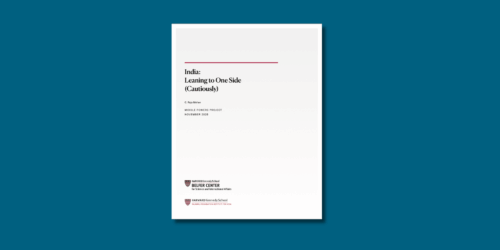
In a new study for the Middle Powers Project, C. Raja Mohan assesses how India’s national ascent towards global influence faces developmental constraints, maintaining that the country must balance ties with China and the United States to harness its economic potential and situate itself as a leader in the Global South. The Middle Powers Project is in collaboration with the Belfer Center for Science and International Affairs.
Case Study
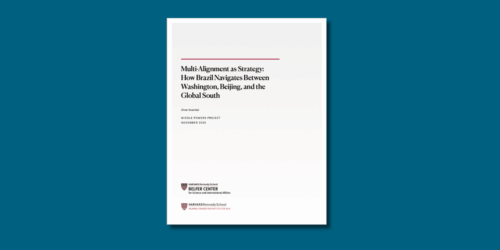
In a new study for the Middle Powers Project, Oliver Stuenkel explains how Brazil’s self-perception as a “giant by nature” advances its foreign policy with a strategy of multi‑alignment. As Brazil strives to balance relationships with both China and the United States and solidify its roles in BRICS and the G20, the country’s autonomy is pressured by great-power rivalry and its regional influence remains limited. The Middle Powers Project is in collaboration with the Belfer Center for Science and International Affairs.
Video
Tony Saich, Director of the Rajawali Foundation Institute for Asia, gives an expert interview for the Fairbank Center for Chinese Studies at Harvard University on understanding China’s political governance.
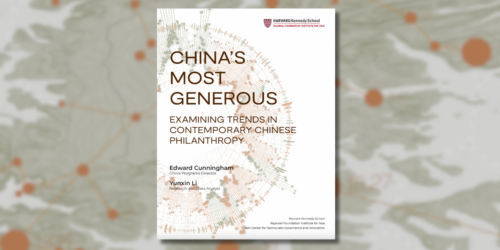
Media Release
The Rajawali Foundation at Harvard Kennedy School released, “China’s Most Generous – Examining Trends in Contemporary Chinese Philanthropy”, which provides insights into current trends among China’s major donors and recipients.
Report
This report on elite philanthropy presents the latest findings from the Harvard Kennedy School Rajawali Foundation Institute’s China Philanthropy Project and provides insight into current trends among China’s major donors and recipients.
Video
Anthony Saich, the director of the Rajawali Foundation Institute for Asia and Daewoo Professor of International Affairs recently spoke at the China Centre, University of Sydney about President Donald J. Trump and his relationship with China.
This talk, entitled “An Unpredictable President and U.S. China Relations”, provides an initial analysis of how a second Trump administration could influence US-China relations forecasting his approach, and figuring out whether he will adopt the role of a deal-maker or take a more combative stance aimed at undermining rivals.
Saich focuses on three key areas of concern: tariffs, Taiwan, and technology controls.
Q+A
From the potential for revived tariffs to the implications for global collaboration, Rajawali Director Tony Saich examines the key dynamics shaping what could be a pivotal era in US-China relations.
Occasional Paper
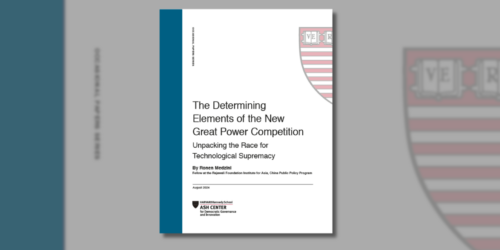
In his latest occasional paper, Ronen Medzini, Rajawali Fellow, explains that while the US and China are not strangers to the “great power” competition, technology supremacy has superseded ideology as what lies at the crux of these dynamics. He goes on to examine critical technologies, their key attributes, and their impacts on national security, commerce, and society while exploring strategies for achieving technological superiority.
Occasional Paper
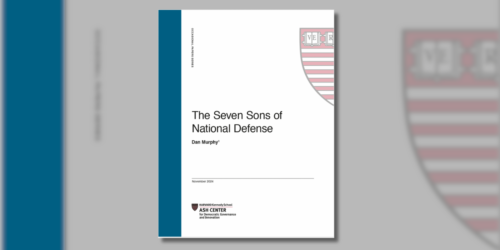
In his latest occasional paper, Dan Murphy explores whether partnering with these universities is advisable given the national security implications. Murphy argues that while caution is warranted, American universities should not shy away from all potential collaborations with the Seven Sons.

Essay
The population is declining in more than 60 countries, in many cases dramatically. Families with one or no children are becoming increasingly common. The challenges are global, with far-reaching consequences.
Media Release
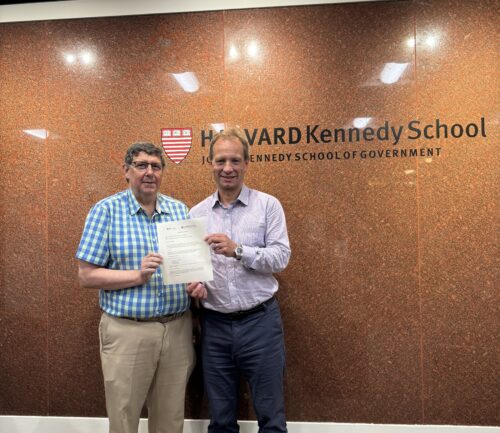
The Rajawali Foundation Institute for Asia at the Harvard Kennedy School, Harvard University and the East Asian Institute (EAI) at the National University of Singapore, are delighted to announce a new academic collaboration.
Feature
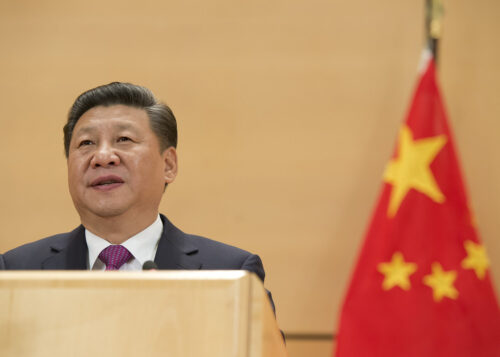
Chinese President Xi Jinping has laid out his vision for China’s economic and social future – and it places Xi Jinping at the very center.
Feature
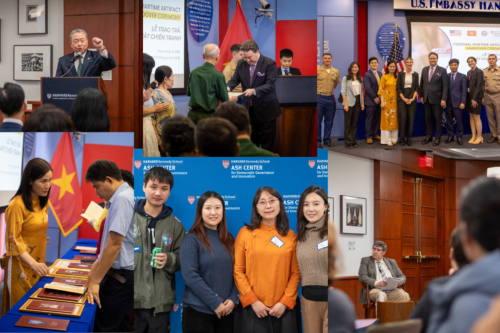
This past semester, the Rajawali Foundation Institute for Asia engaged in conversations and research on topics ranging from Indonesia’s election to US-Taiwan relations with the goal of continuing to develop policy solutions to the region’s most pressing concerns.
Video
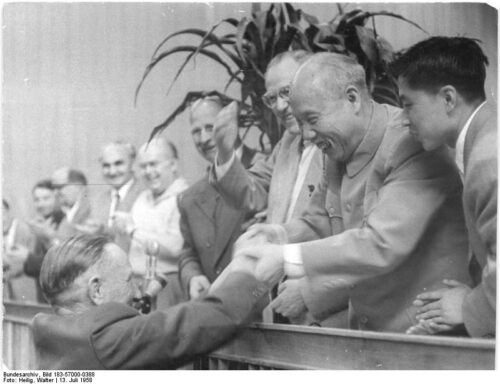
The Rajawali Institute Foundation for Asia hosted a book talk with Axel Berkofsky, author of China-GDR Relations from 1949 to 1989: The (Bad) Company You Keep (Springer, 2022).