Read the latest news, commentary, and analysis from the Rajawali Foundation Institute for Asia.
1
Feature
SFFA vs. Kamehameha Schools: Beyond Affirmative Action and the Implications for Indigenous Communities—Event Summary
A summary of the Wednesday, April 8 event exploring the legal and political stakes of Students for Fair Admissions’ (SFFA) new case and what it means for Native Hawaiian self-determination.
SFFA vs. Kamehameha Schools: Beyond Affirmative Action and the Implications for Indigenous Communities—Event Summary
A summary of the Wednesday, April 8 event exploring the legal and political stakes of Students for Fair Admissions’ (SFFA) new case and what it means for Native Hawaiian self-determination.
Implications of a Rapidly Changing World: Technology, Digital Transformation, and Geopolitical Realignments: Joint Conference Summary
A summary of the December 11-12, 2025 conference, jointly organized by the Rajawali Foundation Institute for Asia, John F. Kennedy; School of Government, Harvard University; East Asian Institute, National University of Singapore (NUS); and the National School of Development, Peking University.
In Partnership with Lee Kuan Yew School of Public Policy, NUS.
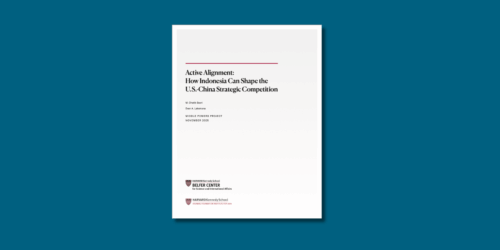
Q&A with M. Chatib Basri on “Active Alignment: How Indonesia Can Shape the U.S.-China Strategic Competition”
M. Chatib Basri answers questions about his paper, exploring Indonesia’s strategic alignment and leverage, maritime position, and the implications of domestic reform on Indonesia’s regional impact.
Q & A with Ning Leng, Author of “Politicizing Business: How Firms Are Made to Serve the Party-State in China”
Ning Leng, Assistant Professor at the McCourt School of Public Policy at Georgetown University, and former postdoc at the Rajawali Foundation Institute for Asia, answers questions on her newly released book Politicizing Business: How Firms Are Made to Serve the Party-State in China, exploring politics, economy and authoritarian institutions in China.
Fifty Years On: New Perspectives on the Vietnam Wars – Day Two
The second day of Fifty Years On: New Perspectives on the Vietnam Wars continued the conversations from Day One, exploring the wars’ lasting global and human impact. Building on the first day’s scholarship and personal reflections, Day Two featured three panels and a final roundtable. A first article covers Day One.
Fifty Years On: New Perspectives on the Vietnam Wars – Day One
The first day of the Fifty Years On: New Perspectives on the Vietnam Wars conference presented new scholarship and firsthand reflections that expanded how the Vietnam Wars are remembered and studied. Scholars, veterans, and practitioners examined the conflict from multiple perspectives, centering Vietnamese and other international voices often missing from traditional narratives. A second article covers Day Two.
Vietnamese Diaspora: The Ongoing Journey of Conflict and Reconciliation
Fifty years after the fall of Saigon, the panel “Vietnamese Diaspora: The Ongoing Journey of Conflict and Reconciliation,” highlighted personal and intergenerational experiences of loss, resilience, and renewal, offering insight into how the Vietnam Wars continue to shape Vietnamese communities today.
Reflections on the Vietnam Wars and Frank and Catherine Jao’s Role in Advancing Reconciliation
Wars end, but the story of how they are remembered, and how people heal from them, continues. On Friday, October 3, during Fifty Years On: New Perspectives on the Vietnam Wars — a two-day conference hosted by Harvard University’s Global Vietnam Wars Studies Initiative — Archon Fung, Winthrop Laflin McCormack Professor of Citizenship and Self-Government and director of the Ash Center for Democratic Governance and Innovation, shared remarks reflecting on memory, reconciliation, and the enduring lessons of conflict. Convened 50 years after the fall of Saigon, the conference brought together scholars, veterans, and practitioners to explore how the wars in Vietnam, Cambodia, and Laos continue to shape politics, remembrance, and global relationships today.