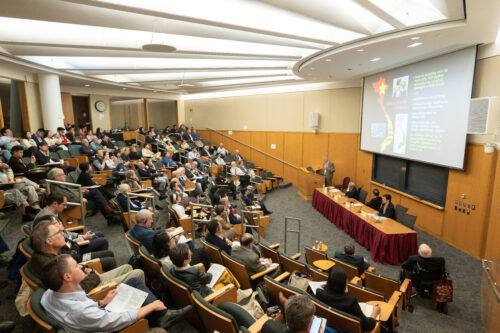
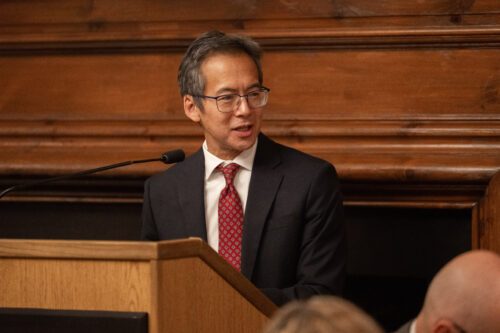
Following the first day of scholarship and reflection, day two of Fifty Years On: New Perspectives on the Vietnam Wars opened with brief welcome remarks from Tony Saich, director of the Rajawali Foundation Institute for Asia and Daewoo Professor of International Affairs. The two-day conference, hosted by the Global Vietnam Wars Studies Initiative (GVWSI) housed at the Rajawali Foundation Institute for Asia, and the Southeast Asia Initiative at the Asia Center, convened scholars, veterans, and community members from around the world to examine the wars’ complex histories and legacies. Together, participants sought to deepen global understanding of the conflicts and foster pathways toward reconciliation.
Building on the momentum of the previous day, Day Two turned to new case studies, emerging research, and ongoing reflections on memory, healing, and the human costs of war.
Panel 5: Battlefield Experience, Conflict, and Memory
Moderated by Nathalie Huynh Chau Nguyen, professor of history at Monash University and fellow of the Academy of the Social Sciences in Australia, the fifth panel turned toward lived experiences, with presentations on how the Vietnam Wars were felt, remembered, and narrated by those who fought in them. Bringing together perspectives from China, Vietnam, and the United States, the discussion highlighted the human dimensions of warfare.
Xiao Bing Li, professor of history, director of Western Pacific Institute, and Don Betz Endowed Chair in International Studies at the University of Central Oklahoma, opened with Buried Memory: Untold Stories of Chinese Soldiers in the Vietnam War, 1965–1971, exploring the silence surrounding China’s involvement in the conflict. Lo Khac Tam, a major general in the People’s Army of Vietnam, followed with Lived Experiences in the Battlefield of a North Vietnamese Soldier, offering a rare firsthand account that offered a more human-centered understanding. Ron Milam, professor of military history at Texas Tech University, examined The U.S. Combat Soldier in Vietnam Comes Home, reflecting on the difficult transition to civilian life faced by American veterans. Lastly, Nguyen closed with Military Pioneers: South Vietnam’s Women in Uniform, drawing on oral histories to recover the experiences of South Vietnamese servicewomen and how they balanced military duty with family and tradition.
Panel 6: Gender & Culture
The next panel, moderated by Heather Stur, professor of history at the University of Southern Mississippi and senior fellow at the Dale Center for the Study of War & Society, explored the Vietnam Wars through the lenses of gender, identity, and cultural expression. Stur opened with Seeing Combat: American Women in the Vietnam War, reframing what it meant to “see combat” by examining the experiences of women, particularly Army nurses, who faced war trauma.
Maya Nguyen, lecturer in international relations at SOAS, University of London, followed with Participation of Children and Youth in the Vietnam War: Communism, Confucianism, and Childhood, shedding light on the often-overlooked agency of young participants in the war. Jane Griffith shared Vietnamese Women in the National Liberation Front, drawing on her humanitarian work in South Vietnam to document the vital roles women played within the National Liberation Front (NLF). Closing the panel, Ann Marie Leshkowich, professor of anthropology at College of the Holy Cross, and Martina Nguyen, associate professor of history at Baruch College, City University of New York, presented The Vietnamese Áo Dài in a Time of War: Fashion, Citizenship, and Nationalism (1954–1975), exploring the role Vietnam’s national costume, the áo dài, played and illustrating how two “first ladies” of Vietnamese laddies used fashion for cultural and political expression.
Panel 7: The War at Home in America
Moderated by Christian Appy, director of the Ellsberg Initiative for Peace and Democracy and professor of history at the University of Massachusetts, Amherst, the final panel examined the Vietnam Wars from the American home front. Jacob Ganz, program manager for the Wargaming and Crisis Simulation Initiative at the Hoover Institution, opened with Unheeded Warnings: The Sigma Wargames of 1964 and the Path to Vietnam, analyzing how early wargaming predicted U.S. strategic failures, yet its lessons were ignored. Connor Mitchell, a member of the American Historical Association with an MA from American University, followed with Dancing in Dissonance: The 1968 Tet Offensive and the Disconnect Between Washington D.C. and Saigon, revealing how the disconnect between U.S. political and military leadership hindered the country’s war efforts.
Chester Pach, a professor of history at Ohio University, then presented War within the War: Television News Coverage of the Vietnam War and Its Controversial Legacies, examining the contentious relationship between journalists and the U.S. government. Appy closed the session with a reflection on the Pentagon Papers, Did The Pentagon Papers Help End the Vietnam War?, asking whether Daniel Ellsberg’s 1971 leak helped end the war. He emphasized that the Papers’ release and the administration’s reaction were pivotal in fostering widespread distrust of presidential authority and shaping opposition to the war.
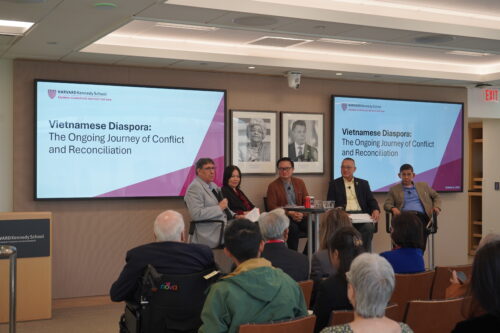
Roundtable 2: The Assessment
Day Two concluded with a second roundtable, The Assessment, moderated by Robert Brigham, a specialist in U.S. foreign policy and the Vietnam Wars. Brigham framed the discussion broadly, noting that “assessment — at this date and time, in this conference — can mean many things,” from reflecting on the conference itself to considering the war’s enduring legacies and the current state of scholarship. He highlighted the intergenerational nature of the war’s impact, with young scholars and older participants alike connecting to Vietnam in different ways.
Participants each brought their own relationship with the Vietnam Wars to the table and assessed their learnings and reflections over the past two days in different ways. Mark Lawrence, former director of the LBJ Presidential Library, explored continuities between the first and second Indochina wars; debated whether the Vietnam Wars should be understood as a civil, revolutionary, or international conflict; and reflected on the massive diversion of U.S. resources. Justin Simundson, assistant professor of history at the U.S. Air Force Academy, assessed the experiences of American combat infantry and how these narratives have evolved within broader historiography.
Andrew Wiest, founding director of the Dale Center for the Study of War and Society at the University of Southern Mississippi, examined the postwar impact on the U.S. National Guard. Finally, Kenneth Quinn, former U.S. ambassador to Cambodia, reflected on the Tet Offensive and the six hours when the Viet Cong breached the U.S. embassy, describing them as pivotal moments that continue to influence American political divisions. Brigham then guided the discussion with follow-up questions.
Closing Remarks
Saich closed the conference by thanking participants for “a couple of days of very thoughtful and engaging discussion” and for sharing their ideas and insights. He emphasized how the presentations had deepened understanding of the Vietnam Wars, broadened dialogue around reconciliation, and illuminated the human costs of conflict. Saich highlighted the work still ahead for the next generation of Vietnam Wars studies and noted that research on Vietnam will remain central to the evolving Global Conflict and Reconciliation Program, which seeks to “bring out from the shadows those who were hidden from history” and guide how we confront past and present challenges.