
Video  

An Unpredictable President and US-China Relations

Anthony Saich, the director of the Rajawali Foundation Institute for Asia and Daewoo Professor of International Affairs recently spoke at the China Centre, University of Sydney about President Donald J. Trump and his relationship with China.

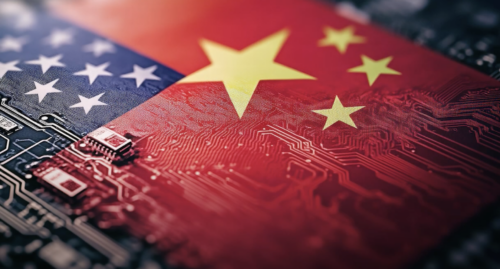
This talk, entitled “An Unpredictable President and U.S. China Relations”, provides an initial analysis of how a second Trump administration could influence US-China relations forecasting his approach, and figuring out whether he will adopt the role of a deal-maker or take a more combative stance aimed at undermining rivals.

Saich focuses on three key areas of concern: tariffs, Taiwan, and technology controls.

More from this Program

See All Programs

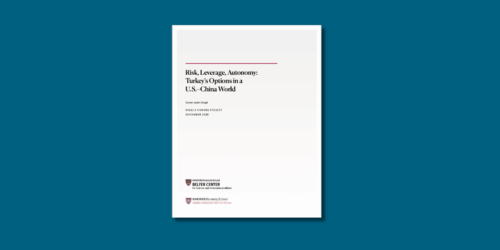
Risk, Leverage, Autonomy: Turkey’s Options in a U.S.–China World
A cover photo of the report.

Case Study

Risk, Leverage, Autonomy: Turkey’s Options in a U.S.–China World

In a new study for the Middle Powers Project, Senem Aydin-Düzgit explores how Turkey’s position as a strategically autonomous power enables the country to balance ties with the Western and non-Western world, while economic vulnerabilities present challenges for Turkey’s pursuit of its foreign policy goals. The Middle Powers Project is in collaboration with the Belfer Center for Science and International Affairs. 
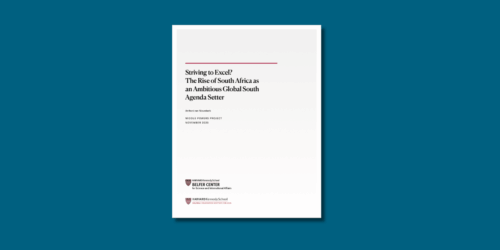
Striving to Excel? The Rise of South Africa as an Ambitious Global South Agenda Setter
A cover photo of the report.

Case Study

Striving to Excel? The Rise of South Africa as an Ambitious Global South Agenda Setter

In a new study for the Middle Powers Project, Anthoni van Nieuwkerk examines how South Africa’s identity as a key middle power shapes the priorities of the Global South, yet the country’s foreign policy of active nonalignment inhibits its ability to fully embody a leadership role. The Middle Powers Project is in collaboration with the Belfer Center for Science and International Affairs. 
Active Alignment: How Indonesia Can Shape the U.S.-China Strategic Competition
A cover photo of the report.

Case Study

Active Alignment: How Indonesia Can Shape the U.S.-China Strategic Competition

In a new study for the Middle Powers Project, M. Chatib Basri and Evan A. Laksmana explore how “active alignment” can help Indonesia shape strategic competition between the United States and China, facilitating cooperation between the major powers to support Indonesia’s own strategic priorities. The Middle Powers Project is in collaboration with the Belfer Center for Science and International Affairs. 
More on this Location

India: Leaning to One Side (Cautiously)
A cover photo of the report.

Case Study

India: Leaning to One Side (Cautiously)

In a new study for the Middle Powers Project, C. Raja Mohan assesses how India’s national ascent towards global influence faces developmental constraints, maintaining that the country must balance ties with China and the United States to harness its economic potential and situate itself as a leader in the Global South. The Middle Powers Project is in collaboration with the Belfer Center for Science and International Affairs. 
Multi-Alignment as Strategy: How Brazil Navigates Between Washington, Beijing, and the Global South
A cover photo of the report.

Case Study

Multi-Alignment as Strategy: How Brazil Navigates Between Washington, Beijing, and the Global South

In a new study for the Middle Powers Project, Oliver Stuenkel explains how Brazil’s self-perception as a “giant by nature” advances its foreign policy with a strategy of multi‑alignment. As Brazil strives to balance relationships with both China and the United States and solidify its roles in BRICS and the G20, the country’s autonomy is pressured by great-power rivalry and its regional influence remains limited. The Middle Powers Project is in collaboration with the Belfer Center for Science and International Affairs. 
Understanding China’s Political Governance
The Chinese flag in front of skyscrapers.

Video

Understanding China’s Political Governance

Tony Saich, Director of the Rajawali Foundation Institute for Asia, gives an expert interview for the Fairbank Center for Chinese Studies at Harvard University on understanding China’s political governance.