Fifty Years On: New Perspectives on the Vietnam Wars – Day One
The first day of the Fifty Years On: New Perspectives on the Vietnam Wars conference presented new scholarship and firsthand reflections that expanded how the Vietnam Wars are remembered and studied. Scholars, veterans, and practitioners examined the conflict from multiple perspectives, centering Vietnamese and other international voices often missing from traditional narratives. A second article covers Day Two.
The fall of Saigon in 1975 marked the culmination of decades of war across Vietnam, Laos, and Cambodia. Half a century later, the Vietnam Wars continue to shape how we understand conflict, memory, and reconciliation. Yet too often, discussion and research have focused primarily on American perspectives and experiences.
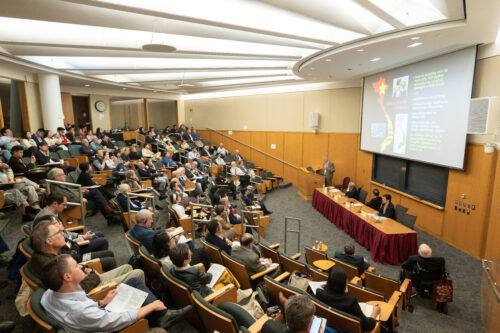
On October 3–4, 2025, the Global Vietnam Wars Studies Initiative (GVWSI) hosted Fifty Years On: New Perspectives on the Vietnam Wars at Harvard University. The conference was organized in collaboration with the Rajawali Foundation Institute for Asia and the Southeast Asia Initiative at the Asia Center and made possible through the support of Frank and Catherine Jao, Founding Donors of the Harvard Global Vietnam Wars Studies Program. It brought together scholars, veterans, and practitioners for an evidence-based, in-depth exploration of the conflict and its legacies. By broadening dialogue around the wars and highlighting their global and intergenerational impacts, the event aimed to shed new light on our history and its relevance to today’s conflicts.
Opening Remarks
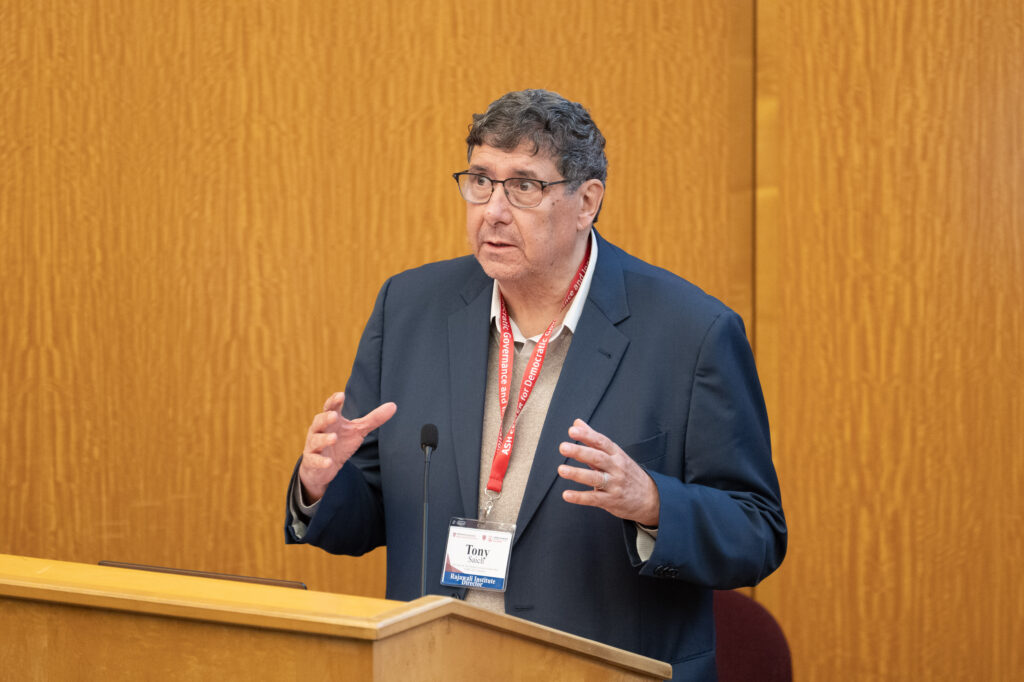
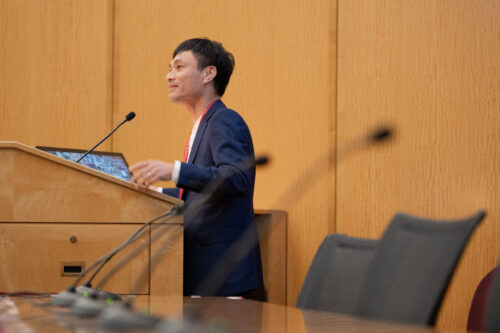
In his welcoming remarks, Tony Saich, director of the Rajawali Foundation Institute for Asia and Daewoo Professor of International Affairs, urged the audience to view the Vietnam Wars as more than an American story. “Too often, Vietnamese and international perspectives have been overshadowed by a focus on American memories,” he noted. “This leaves the broader tragedy of the war — the full human cost, the global reverberations — still neglected and still, in some ways, remaining untold.”
Saich encouraged participants to treat the “rare and diverse” gathering as an opportunity to re-examine familiar narratives. By centering multiple nations and perspectives over seven panels and two roundtables, he explained, “we’ll be able to examine how interpretations of victory and loss have shaped national identities, policies, and strategies over these past five decades, while we look at confronting the continuing challenges around healing, reconciliation, and also addressing lingering legacies.”
Tony Saich, Director of Rajawali Foundation Institute of Asia.
Panel 1: The United States
The first panel examined American engagement in the Vietnam Wars through three 15-minute presentations followed by a Q&A. Christopher Goscha, moderator and professor of international relations at the University of Quebec at Montreal, opened with a discussion on how Americans perceived Vietnam’s strategic value long before troops were deployed in 1965, drawing on his work At the Indochinese Faultline: The Wars Before the Wars and Why They Might Matter. David Biggs, professor and chair of the History Department at UC Riverside then focused on human experiences of ecological warfare in Where They Were: Human Perspectives on Land and Ecowar in Vietnam, showing how Vietnamese communities navigated the effects of chemicals, aerial bombardment, and rapid construction. Finally, Geoffrey Wawro, University Distinguished Research Professor and founding director of the Military History Center, addressed questions about whether the conflict was winnable. He argued that American defeat extended beyond the battlefield, shaped by debt, protest, and strategic overreach, as explored in his book, The Vietnam War: A Military History.
Panel 2: South Vietnam
The second panel turned to South Vietnam, reflecting what moderator Edward Miller, a professor of history and Asian studies at Dartmouth College, described as “a new wave of scholarship on South Vietnam, variously defined, and the role of South Vietnam and South Vietnamese in the history of the Vietnam wars.” Miller’s paper, South Vietnam’s Civil Wars: Sovereignty, Space, and Violence in the Mekong Delta, argued that viewing the conflict as both a civil and imperial war helps explain the interventions of France and the United States and the war’s eventual course.
Sean Fear, lecturer in international history at University of Leeds, examined domestic politics during the Second Republic in Collapse from Within? The Rise and Fall of South Vietnam’s Second Republic 1967-1975, questioning the experience of being governed in provincial towns. Edwin Moise, a professor of history at Clemson University, contextualized President Nguyen Van Thieu’s lack of opposition when the United States began withdrawing U.S. ground troops in 1969 in Whose Combat Infantry? Finally, Phi Van Nguyen, associate professor of history at the Université de Saint-Boniface, presented The Politics of Nationhood in Non-Communist Vietnam: Ruling over Constituents as Migrants in the Associated State of Vietnam and the Republic of Vietnam 1949-1956, on state responses to population movements in the State (and later the Republic) of Vietnam.
Keynote Address
Next, Fredrik Logevall, Harvard University’s Laurence D. Belfer Professor of International Affairs and Pulitzer Prize–winning author of Embers of War: The Fall of an Empire and the Making of America’s Vietnam, gave the program’s keynote address: “Reflections on America’s War.” Logevall urged attendees to continue “to internationalize our understanding of the war” through new scholarship that draws on Vietnamese sources but cautioned that “decentering the United States brings its own problems—its own narrowness.” He linked the war’s legacy to enduring social fissures in the United States, including mistrust of government and cynicism about institutions, warning that such cynicism “threatens democracy because it erodes the power of the people to believe in change and to work for change.” His advice: “Be skeptical; don’t be cynical.” Drawing lessons from the United States’ intervention, he closed by underscoring that wars need to be won politically, counterinsurgency is costly and uncertain, and exaggerating stakes can undermine credibility and blur the line between policy and politics.
He then introduced GVWSI Co-Founder and Director Hai Nguyen, who offered an “Introduction to GVWSI,” sharing a moving video of Vietnam Wars survivors who, after decades of silence, are beginning to tell their stories. “We do this not only for scholarship but for reconciliation and healing,” said Nguyen. He announced that GVWSI would expand its focus beyond Vietnam through the new Global Conflict and Reconciliation Program, dedicated to studying conflicts and healing efforts worldwide. Saich welcomed this new chapter, noting that the program will “carry forward the spirit of the work we’ve done to date, combining rigorous scholarship with a people-balanced approach.”
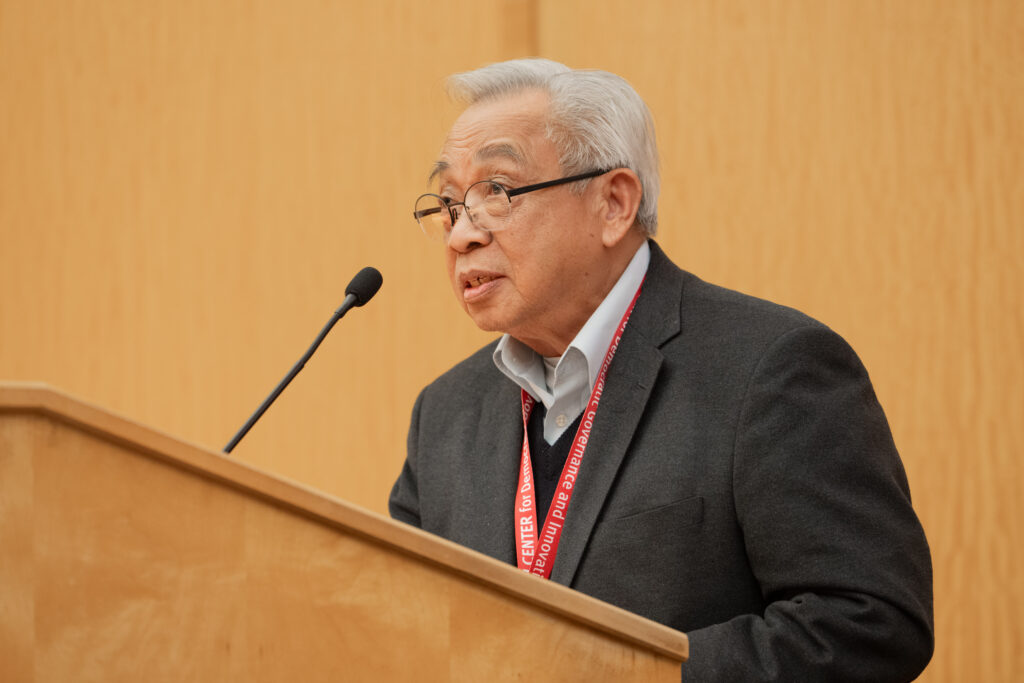
The announcement was followed by remarks from Frank Jao, Founding donor of GVWSI, whose lifelong commitment to reconciliation continues to shape the program’s vision. Reflecting on his journey from South Vietnam to the founding of Little Saigon and his later work in education, Jao spoke of his pursuit of healing after trauma. “Vietnam was only one chapter in the much longer story of human suffering,” he said. With the world “as fragile as it is today,” he announced a multi-year commitment to support the Global Conflict and Reconciliation Program, aiming to help scholars, leaders, and policymakers “build a better future for our children and grandchildren and generations to come.”
Mr. Frank Jao speaking at the Fifty Years On conference.
Panel 3: North Vietnam
The third panel turned to North Vietnam, with moderator Pierre Asselin, the Dwight E. Stanford Chair in American Foreign Relations at San Diego State University, leading a discussion that brought together three scholars from Vietnam. Ho Son Dai, historian and senior researcher at Ho Chi Minh City University of Education, presented The Role of General Nguyen Chi Thanh in the South Vietnam Battlefield (1964–1967), highlighting Thanh as a pivotal yet understudied figure. Dang Kim Son, an independent researcher and author of 14 books, spoke on Ho Chi Minh’s Wartime Ideology, advancing a new interpretation of Ho’s political thought as fundamentally oriented toward peace rather than war.
Nguyen Manh Ha, a senior researcher and lecturer specializing in Vietnamese military history, examined The Role of Le Duan, the First Secretary of the Party, in the Vietnam War (1954–1975), presenting Le Duan as both a policy architect and proactive strategist, coordinating political, military, and diplomatic efforts. Asselin concluded the session with Hanoi’s Cultural Diplomatic Offensive, 1965–75, which explored how Communist authorities weaponized traditional culture and enlisted northern artists and intellectuals to shape international perceptions and bolster anti-American resistance.
Panel 4: International Perspectives
The final panel of the day broadened the discussion, examining how the Vietnam Wars reverberated through international politics and the Cold War. Moderator James Hershberg, professor of history and international affairs at George Washington University, noted that while President Johnson sought broad allied support for the war, enthusiasm was limited, and even supporters offered complex, conditional commitments.
Yu Yao, professor of history at East China Normal University, opened with Threats from the Anti-Chinese Alliance and Beijing’s Policy Towards the Vietnam War: 1963–1965, showing how China balanced public support for the Indochinese communists with private caution to avoid direct confrontation with the United States. Hershberg followed with Moscow, Hanoi, and the Escalation of the Vietnam War, presenting new findings from Soviet and Soviet Bloc archives that illuminate new aspects of the war’s international aspects. Then, Mitsuaki Ono, professor of sociology at the University of Shiga Prefecture, explored The Transnational Dimension of the Anti-Vietnam War Movement in Okinawa, examining the relationship among Okinawan activists, Black GIs, and American antiwar organizers. Su Jeong Ku closed with A War with Two Memories: South Korea and Vietnam, contrasting the nations’ divergent memorial cultures.
Roundtable 1: War Legacies and Reconciliation
Day one concluded with a deeply personal roundtable on the lasting human impact of the Vietnam Wars and various personal paths toward healing. Moderated by James Willbanks, a Vietnam veteran and professor emeritus of military history, the discussion brought together individuals whose lives have been profoundly shaped by the conflict: Takeshi Furumoto, a Japanese American intelligence officer who served in Hau Nghia in 1970; Hoang Thi Khanh, a former political prisoner at Con Dao who now leads Ho Chi Minh’s Liaison Committee for Former Political Prisoners and Prisoners of War; Nguyen Thanh Thuy, a former special police major who spent 13 years in re-education camps; and Tran Ngoc Hue, a decorated officer of the Army of the Republic of Vietnam held as a prisoner of war for over a decade.
Opening the conversation, Willbanks invited the group to reflect not on policy but on their lived experience, asking: “What are the lasting legacies for those who bore the weight of the war? What does reconciliation look like between former enemies, not in policy papers but in lived experience? And how can we, as former enemies who fought in a bitter war, go forward?” Each participant shared their journey toward understanding and reconciliation, revealing the human cost of war and offering the possibility of empathy across divides. Rather than seeking answers, the roundtable opened space for reflection and healing.
Fifty Years On: New Perspectives on the Vietnam Wars – Day Two
The second day of Fifty Years On: New Perspectives on the Vietnam Wars continued the conversations from Day One, exploring the wars’ lasting global and human impact. Building on the first day’s scholarship and personal reflections, Day Two featured three panels and a final roundtable. A first article covers Day One.
Vietnamese Diaspora: The Ongoing Journey of Conflict and Reconciliation
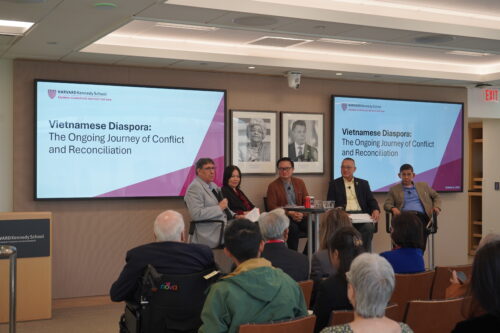
Fifty years after the fall of Saigon, the panel “Vietnamese Diaspora: The Ongoing Journey of Conflict and Reconciliation,” highlighted personal and intergenerational experiences of loss, resilience, and renewal, offering insight into how the Vietnam Wars continue to shape Vietnamese communities today.
Reflections on the Vietnam Wars and Frank and Catherine Jao’s Role in Advancing Reconciliation
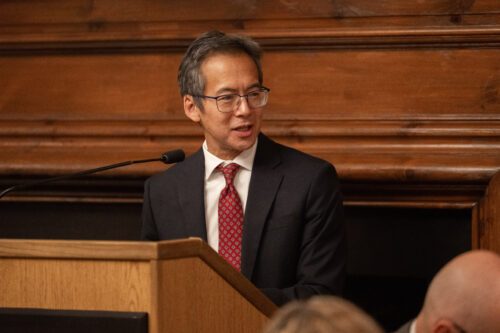
Wars end, but the story of how they are remembered, and how people heal from them, continues. On Friday, October 3, during Fifty Years On: New Perspectives on the Vietnam Wars — a two-day conference hosted by Harvard University’s Global Vietnam Wars Studies Initiative — Archon Fung, Winthrop Laflin McCormack Professor of Citizenship and Self-Government and director of the Ash Center for Democratic Governance and Innovation, shared remarks reflecting on memory, reconciliation, and the enduring lessons of conflict. Convened 50 years after the fall of Saigon, the conference brought together scholars, veterans, and practitioners to explore how the wars in Vietnam, Cambodia, and Laos continue to shape politics, remembrance, and global relationships today.
Fifty Years On: New Perspectives on the Vietnam Wars – Day Two
The second day of Fifty Years On: New Perspectives on the Vietnam Wars continued the conversations from Day One, exploring the wars’ lasting global and human impact. Building on the first day’s scholarship and personal reflections, Day Two featured three panels and a final roundtable. A first article covers Day One.
Vietnamese Diaspora: The Ongoing Journey of Conflict and Reconciliation
Fifty years after the fall of Saigon, the panel “Vietnamese Diaspora: The Ongoing Journey of Conflict and Reconciliation,” highlighted personal and intergenerational experiences of loss, resilience, and renewal, offering insight into how the Vietnam Wars continue to shape Vietnamese communities today.
Reflections on the Vietnam Wars and Frank and Catherine Jao’s Role in Advancing Reconciliation
Wars end, but the story of how they are remembered, and how people heal from them, continues. On Friday, October 3, during Fifty Years On: New Perspectives on the Vietnam Wars — a two-day conference hosted by Harvard University’s Global Vietnam Wars Studies Initiative — Archon Fung, Winthrop Laflin McCormack Professor of Citizenship and Self-Government and director of the Ash Center for Democratic Governance and Innovation, shared remarks reflecting on memory, reconciliation, and the enduring lessons of conflict. Convened 50 years after the fall of Saigon, the conference brought together scholars, veterans, and practitioners to explore how the wars in Vietnam, Cambodia, and Laos continue to shape politics, remembrance, and global relationships today.