On October 16, the Chinese Communist Party (CCP) will convene its 20th Party Congress. Held every five years, the Congress is a critical event. While nothing is seriously debated there, the symbolic function of the Congress is extremely important. It summarizes past achievements and sets out future objectives, all while displaying an outward power and unity. The Congress brings together just over 3,000 delegates from the provinces, the People’s Liberation Army (PLA), and some central agencies for about a week to approve the report of the General Secretary, amendments to the party statutes, and any other documents placed before them. In theory, this sets in motion the appointment of a new leadership by electing candidates to the Central Committee (around 200 members and 150 alternates). In reality, the Congress approves the slate proposed by the outgoing Political Bureau (Politburo) and senior leader- ship. In turn, the Central Committee elects members of the Politburo, its Standing Committee, and the Secretariat, again based on lists provided after the Party leadership has finished haggling.
This Congress will be special, as General Secretary Xi Jinping seeks a third term as political leader (either as general secretary or party chairman), confirms his place and ideas even more concretely within the party statutes, and seeks to appoint a leadership cohort drawn from his associates. Below, I provide my best guesstimates on his chances of reappointment, the leadership structure, and indications for future policy trends.
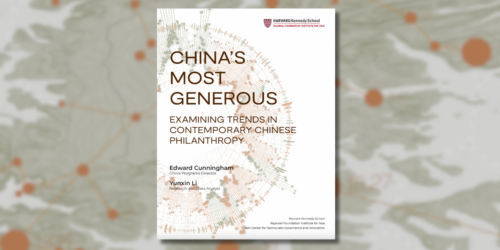
Harvard Kennedy School Releases: China’s Most Generous Report
The Rajawali Foundation at Harvard Kennedy School released, “China’s Most Generous – Examining Trends in Contemporary Chinese Philanthropy”, which provides insights into current trends among China’s major donors and recipients.
Anthony Saich, the director of the Rajawali Foundation Institute for Asia and Daewoo Professor of International Affairs recently spoke at the China Centre, University of Sydney about President Donald J. Trump and his relationship with China.
This talk, entitled “An Unpredictable President and U.S. China Relations”, provides an initial analysis of how a second Trump administration could influence US-China relations forecasting his approach, and figuring out whether he will adopt the role of a deal-maker or take a more combative stance aimed at undermining rivals.
Saich focuses on three key areas of concern: tariffs, Taiwan, and technology controls.
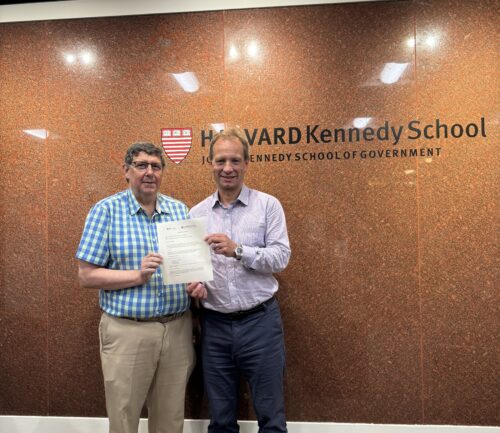
The Rajawali Foundation Institute for Asia and the East Asian Institute (EAI) at the National University of Singapore Forge Academic Partnership
The Rajawali Foundation Institute for Asia at the Harvard Kennedy School, Harvard University and the East Asian Institute (EAI) at the National University of Singapore, are delighted to announce a new academic collaboration.
Q & A with Ning Leng, Author of “Politicizing Business: How Firms Are Made to Serve the Party-State in China”
Ning Leng, Assistant Professor at the McCourt School of Public Policy at Georgetown University, and former postdoc at the Rajawali Foundation Institute for Asia, answers questions on her newly released book Politicizing Business: How Firms Are Made to Serve the Party-State in China, exploring politics, economy and authoritarian institutions in China.
In a new study for the Middle Powers Project, C. Raja Mohan assesses how India’s national ascent towards global influence faces developmental constraints, maintaining that the country must balance ties with China and the United States to harness its economic potential and situate itself as a leader in the Global South. The Middle Powers Project is in collaboration with the Belfer Center for Science and International Affairs.
Multi-Alignment as Strategy: How Brazil Navigates Between Washington, Beijing, and the Global South
In a new study for the Middle Powers Project, Oliver Stuenkel explains how Brazil’s self-perception as a “giant by nature” advances its foreign policy with a strategy of multi‑alignment. As Brazil strives to balance relationships with both China and the United States and solidify its roles in BRICS and the G20, the country’s autonomy is pressured by great-power rivalry and its regional influence remains limited. The Middle Powers Project is in collaboration with the Belfer Center for Science and International Affairs.