Through our books, case studies, journal articles, papers, and surveys, the Rajawali Foundation Institute for Asia is home to some of Harvard’s most advanced research and publications on issues related to the region.
To explore additional Asia-related research from Kennedy School faculty, please visit the Harvard Kennedy School website.
1
Article
Best Practices for Multilingual Outreach—Boston
AAPI Research Leads Jacqueline Chen (MPP 2026) and Katherine Waltman (MPP 2028) spoke with local government practitioners to glean best practices for supporting immigrant communities through language access initiatives.
Macroeconomic Management in Bangladesh: Challenges and Opportunities
This policy brief explores the macroeconomic challenges posed by the politcal upheaval of July-August 2025 and explains that with serious and sustained reform, the country can overcome these hurdles and pursue inclusive growth and development.
Powering Bangladesh’s Future: Risks and Opportunities in Solar Energy Deployment
This policy paper aims to provide an analysis of the current state of the solar power industry in Bangladesh, identifying the gaps and risks associated with the implementation of the government’s renewable energy goals.
The challenge in this policy note is to look beyond the transitory factors in Bangladesh that have moved relative prices up (or down) to identify the longer-term factors that generate and sustain general price increases and to explain why those factors endure.
The tax-to-GDP ratio in Bangladesh has been exceptionally low, both absolutely and relative to the nation’s peers, for the last five decades. An excellent starting point for reform would be the World Bank’s recent proposals for enhanced revenue mobilization, which build upon the long-delayed reforms.
This policy note discusses the macroeconomic difficulties in Bangladesh created by the counterproductive manipulation of the exchange rate from the mid-2000s and suggests potential remedies.
The study aimed to determine if Bangladesh’s decades-long high-level performance contradicted the widely accepted “stylized fact” among development specialists that “institutions matter.”
Tax System Digitalization to Enhance Revenue Mobilization in Bangladesh
This policy brief focuses on improving tax implementation, with the hope that the impact of administrative reforms will be accelerated and amplified if undertaken simultaneously with fundamental tax policy reform.
China’s Most Generous: Examining Trends in Contemporary Chinese Philanthropy
This report on elite philanthropy presents the latest findings from the Harvard Kennedy School Rajawali Foundation Institute’s China Philanthropy Project and provides insight into current trends among China’s major donors and recipients.
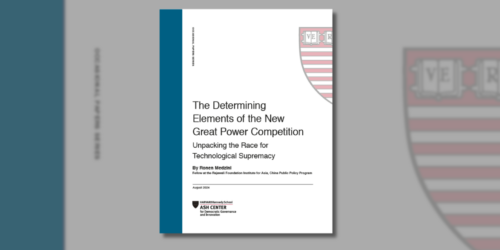
The Determining Elements of the New Great Power Competition: Unpacking the Race for Technological Supremacy
In his latest occasional paper, Ronen Medzini, Rajawali Fellow, explains that while the US and China are not strangers to the “great power” competition, technology supremacy has superseded ideology as what lies at the crux of these dynamics. He goes on to examine critical technologies, their key attributes, and their impacts on national security, commerce, and society while exploring strategies for achieving technological superiority.