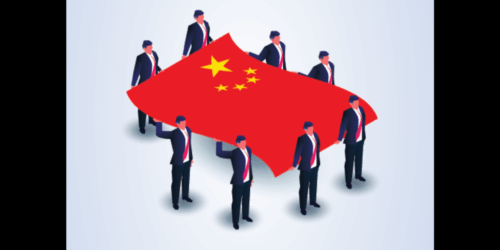
In light of the increasingly aggressive policies and rhetoric of the Chinese government, many came to believe that China may pose a severe threat to democracy and the international order. However, less attention has been paid to Chinese popular attitudes toward democracy and authoritarianism. How does the Chinese public think of democracy in the changing domestic and international environment?
This paper uses a novel data set of Chinese social media posts generated between 2009 and 2017 and investigates the changes in popular attitudes toward democracy in the past decade. Results show that online discussion around democracy has decreased and voices questioning democracy have become pronounced since 2013. While tightened state control is a critical factor shaping popular attitudes, this paper demonstrates that people’s increasing exposure to two types of foreign information has also played into this trend. These information lead to a perception of dissatisfying performance of other countries and an awareness of racial attitudes of the West. Lastly, increasing doubts about democracy are not necessarily translated into a strong authoritarian legitimacy. Instead, online discussion presents a sense of ambivalence toward the two models, and the Chinese regime has continued to face a predicament of legitimacy.
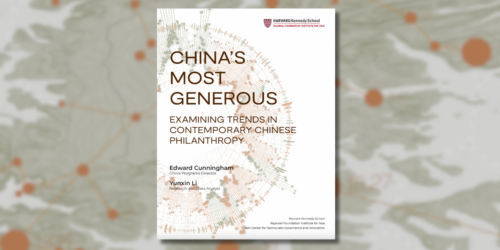
Harvard Kennedy School Releases: China’s Most Generous Report
The Rajawali Foundation at Harvard Kennedy School released, “China’s Most Generous – Examining Trends in Contemporary Chinese Philanthropy”, which provides insights into current trends among China’s major donors and recipients.
Anthony Saich, the director of the Rajawali Foundation Institute for Asia and Daewoo Professor of International Affairs recently spoke at the China Centre, University of Sydney about President Donald J. Trump and his relationship with China.
This talk, entitled “An Unpredictable President and U.S. China Relations”, provides an initial analysis of how a second Trump administration could influence US-China relations forecasting his approach, and figuring out whether he will adopt the role of a deal-maker or take a more combative stance aimed at undermining rivals.
Saich focuses on three key areas of concern: tariffs, Taiwan, and technology controls.
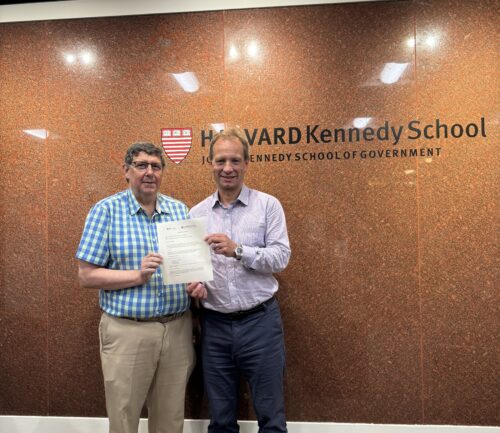
The Rajawali Foundation Institute for Asia and the East Asian Institute (EAI) at the National University of Singapore Forge Academic Partnership
The Rajawali Foundation Institute for Asia at the Harvard Kennedy School, Harvard University and the East Asian Institute (EAI) at the National University of Singapore, are delighted to announce a new academic collaboration.
Q & A with Ning Leng, Author of “Politicizing Business: How Firms Are Made to Serve the Party-State in China”
Ning Leng, Assistant Professor at the McCourt School of Public Policy at Georgetown University, and former postdoc at the Rajawali Foundation Institute for Asia, answers questions on her newly released book Politicizing Business: How Firms Are Made to Serve the Party-State in China, exploring politics, economy and authoritarian institutions in China.
In a new study for the Middle Powers Project, C. Raja Mohan assesses how India’s national ascent towards global influence faces developmental constraints, maintaining that the country must balance ties with China and the United States to harness its economic potential and situate itself as a leader in the Global South. The Middle Powers Project is in collaboration with the Belfer Center for Science and International Affairs.
Multi-Alignment as Strategy: How Brazil Navigates Between Washington, Beijing, and the Global South
In a new study for the Middle Powers Project, Oliver Stuenkel explains how Brazil’s self-perception as a “giant by nature” advances its foreign policy with a strategy of multi‑alignment. As Brazil strives to balance relationships with both China and the United States and solidify its roles in BRICS and the G20, the country’s autonomy is pressured by great-power rivalry and its regional influence remains limited. The Middle Powers Project is in collaboration with the Belfer Center for Science and International Affairs.