This annual report highlights leading results from the most recent data analysis of the Harvard Kennedy School Ash Center’s China Philanthropy Project. Our team gathered 2019 data on over 20,000 donations from 7,166 foundations, 1,220 charitable organizations, and 2,597 universities in China. To focus on elite giving, we further refined our analysis to 4,434 donations of over RMB 1 million (US$0.14 million), given by 4,070 unique donors. The resulting report on top individual, corporate, and organizational philanthropy provides an important view into current trends among China’s major donors and recipients.
In 2019, elite Chinese giving:
was dominated by large organizations (most commonly corporations) rather than individuals,
supported in large part central government policy priorities in the areas of education and poverty alleviation, and
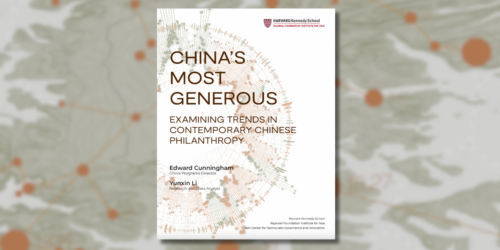
Harvard Kennedy School Releases: China’s Most Generous Report
The Rajawali Foundation at Harvard Kennedy School released, “China’s Most Generous – Examining Trends in Contemporary Chinese Philanthropy”, which provides insights into current trends among China’s major donors and recipients.
China’s Most Generous: Examining Trends in Contemporary Chinese Philanthropy
This report on elite philanthropy presents the latest findings from the Harvard Kennedy School Rajawali Foundation Institute’s China Philanthropy Project and provides insight into current trends among China’s major donors and recipients.
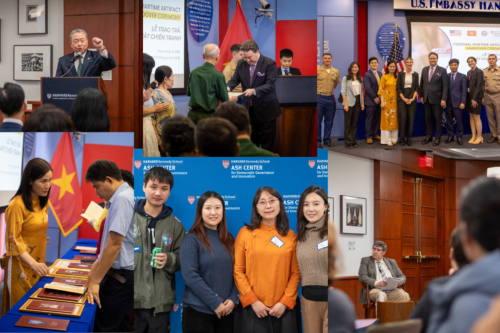
This past semester, the Rajawali Foundation Institute for Asia engaged in conversations and research on topics ranging from Indonesia’s election to US-Taiwan relations with the goal of continuing to develop policy solutions to the region’s most pressing concerns.
Q & A with Ning Leng, Author of “Politicizing Business: How Firms Are Made to Serve the Party-State in China”
Ning Leng, Assistant Professor at the McCourt School of Public Policy at Georgetown University, and former postdoc at the Rajawali Foundation Institute for Asia, answers questions on her newly released book Politicizing Business: How Firms Are Made to Serve the Party-State in China, exploring politics, economy and authoritarian institutions in China.
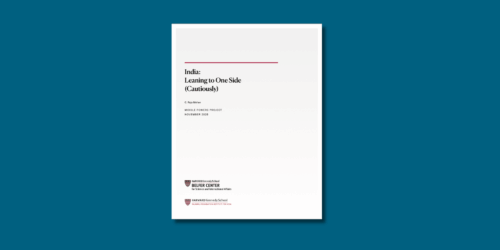
In a new study for the Middle Powers Project, C. Raja Mohan assesses how India’s national ascent towards global influence faces developmental constraints, maintaining that the country must balance ties with China and the United States to harness its economic potential and situate itself as a leader in the Global South. The Middle Powers Project is in collaboration with the Belfer Center for Science and International Affairs.
Multi-Alignment as Strategy: How Brazil Navigates Between Washington, Beijing, and the Global South
In a new study for the Middle Powers Project, Oliver Stuenkel explains how Brazil’s self-perception as a “giant by nature” advances its foreign policy with a strategy of multi‑alignment. As Brazil strives to balance relationships with both China and the United States and solidify its roles in BRICS and the G20, the country’s autonomy is pressured by great-power rivalry and its regional influence remains limited. The Middle Powers Project is in collaboration with the Belfer Center for Science and International Affairs.