Drawing on the expertise of Chinese and Western academics and practitioners, the contributors to this volume aim to advance the understanding of philanthropy for health in China in the 20th century and to identify future challenges and opportunities. Considering government, NGO leaders, domestic philanthropists, and foreign foundations, the volume examines the historical roots and distinct stages of philanthropy and charity in China, the health challenges philanthropy must address, and the role of the Chinese government, including its support for Government Organized Non-Governmental Organizations (GONGOs). The editors discuss strategies and practices of international philanthropy for health; the role of philanthropy in China’s evolving health system; and the prospects for philanthropy in a country beginning to engage with civil society.
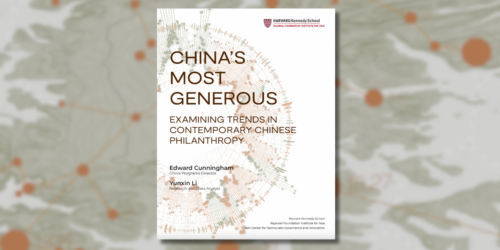
Harvard Kennedy School Releases: China’s Most Generous Report
The Rajawali Foundation at Harvard Kennedy School released, “China’s Most Generous – Examining Trends in Contemporary Chinese Philanthropy”, which provides insights into current trends among China’s major donors and recipients.
China’s Most Generous: Examining Trends in Contemporary Chinese Philanthropy
This report on elite philanthropy presents the latest findings from the Harvard Kennedy School Rajawali Foundation Institute’s China Philanthropy Project and provides insight into current trends among China’s major donors and recipients.
Anthony Saich, the director of the Rajawali Foundation Institute for Asia and Daewoo Professor of International Affairs recently spoke at the China Centre, University of Sydney about President Donald J. Trump and his relationship with China.
This talk, entitled “An Unpredictable President and U.S. China Relations”, provides an initial analysis of how a second Trump administration could influence US-China relations forecasting his approach, and figuring out whether he will adopt the role of a deal-maker or take a more combative stance aimed at undermining rivals.
Saich focuses on three key areas of concern: tariffs, Taiwan, and technology controls.
Q & A with Ning Leng, Author of “Politicizing Business: How Firms Are Made to Serve the Party-State in China”
Ning Leng, Assistant Professor at the McCourt School of Public Policy at Georgetown University, and former postdoc at the Rajawali Foundation Institute for Asia, answers questions on her newly released book Politicizing Business: How Firms Are Made to Serve the Party-State in China, exploring politics, economy and authoritarian institutions in China.
In a new study for the Middle Powers Project, C. Raja Mohan assesses how India’s national ascent towards global influence faces developmental constraints, maintaining that the country must balance ties with China and the United States to harness its economic potential and situate itself as a leader in the Global South. The Middle Powers Project is in collaboration with the Belfer Center for Science and International Affairs.
Multi-Alignment as Strategy: How Brazil Navigates Between Washington, Beijing, and the Global South
In a new study for the Middle Powers Project, Oliver Stuenkel explains how Brazil’s self-perception as a “giant by nature” advances its foreign policy with a strategy of multi‑alignment. As Brazil strives to balance relationships with both China and the United States and solidify its roles in BRICS and the G20, the country’s autonomy is pressured by great-power rivalry and its regional influence remains limited. The Middle Powers Project is in collaboration with the Belfer Center for Science and International Affairs.